
HECM Line Of Credit
HECM Line of Credit: A Secret Weapon in Retirement Planning
Most people have heard of reverse mortgages. Very few understand the HECM line of credit – and that’s a problem.
For many homeowners 62 and older, the HECM LOC can be one of the most powerful, flexible tools in their entire retirement plan. Used wisely, it can add a tax-free* buffer to your income, help you weather market downturns, and provide a stand-by emergency fund that can actually grow over time.
*Consult your tax professional; draws generally come from home equity, not taxable income.
What Is a HECM Line of Credit?
A HECM (Home Equity Conversion Mortgage) is the FHA-insured reverse mortgage program for homeowners 62 and older. When set up as a line of credit on an adjustable-rate HECM, you can:
- Receive a loan amount called your principal limit, based on your age, home value, and interest rates.
- Leave some or all of that principal in a flexible line of credit.
- Draw from it when needed, pay it back voluntarily, and draw again later.
- Have no required monthly mortgage payments as long as you live in the home, keep property taxes and insurance current, pay any HOA dues, and maintain the property.
If you are new to the concept, here’s a helpful overview of our core Retirement Home Loan program.
Key Features of the HECM Line of Credit
The HECM LOC offers several features that are very different from a traditional HELOC:
- Grows over time: The available line of credit can increase over time on an adjustable-rate HECM.
- No required monthly mortgage payments: As long as program obligations are met.
- Interest only on what you use: You’re only charged interest on the amount you actually borrow.
- Flexible prepayments: You can make voluntary payments to reduce the balance and increase future borrowing capacity.
- Non-recourse: You or your heirs never owe more than the home is worth at payoff.
- Stand-by emergency fund: Cash available for medical expenses, home repairs, or filling income gaps.
Understanding How This Grows
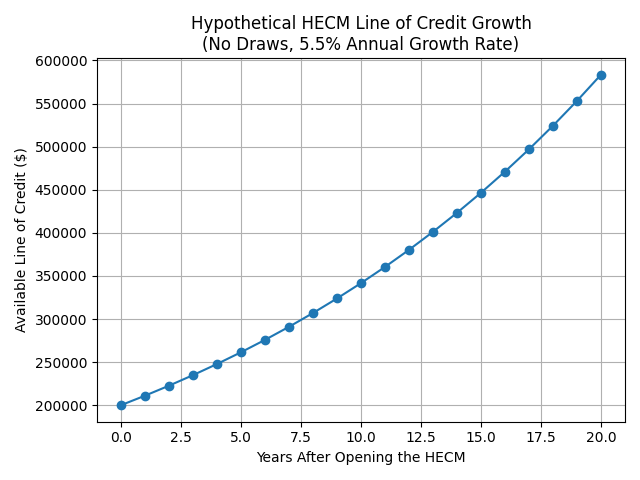
On an adjustable-rate HECM, your principal limit – the maximum you can borrow – increases over time at a rate tied to the interest rate plus the FHA mortgage insurance premium. Because your line of credit is simply the principal limit minus whatever you’ve borrowed, the available line of credit can grow as well.
In plain English: if you open a HECM line of credit and leave it mostly unused, your borrowing capacity can increase over time, even if home values are flat.
How Voluntary Payments Can Increase Future Borrowing Power
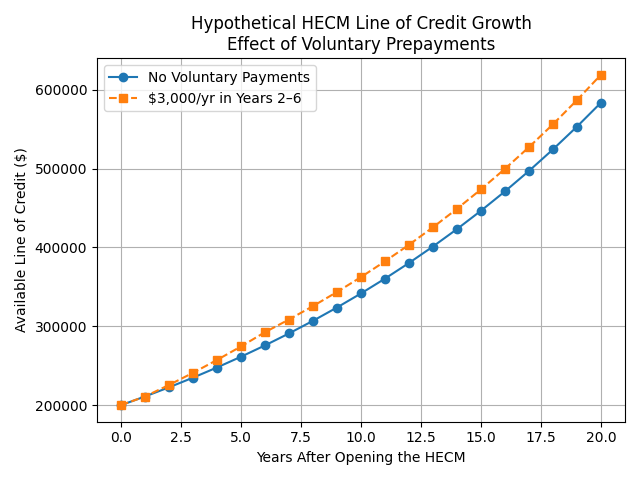
One of the most overlooked advantages of the HECM line of credit is the way voluntary payments can immediately increase your future borrowing capacity. On an adjustable-rate HECM, any optional payment you make is applied through a required “waterfall” sequence: first to accrued FHA mortgage insurance premium (MIP), then to servicing fees (if any), then to interest, and finally to principal.
Although the payment is allocated in that order behind the scenes, the effect for you is clear: your total HECM loan balance is reduced by the full amount you paid. Because the available line of credit is calculated as the difference between your loan balance and your principal limit, reducing your balance causes your available line of credit to increase dollar-for-dollar with every voluntary payment (subject to first-year and program limitations).
For example, if your HECM loan balance is $50,000 and you make a $5,000 voluntary payment, the waterfall determines how that $5,000 is internally allocated — but your overall loan balance is reduced by $5,000. As a result, your available line of credit increases by the full $5,000. This feature is unique to the HECM adjustable line of credit and makes voluntary payments a powerful tool for expanding borrowing power and strengthening long-term retirement flexibility.
Traditional HELOC vs HECM Line of Credit
Both a traditional HELOC and a HECM LOC let you tap home equity. But they behave very differently, especially in retirement:
| Feature | Traditional HELOC | HECM Line of Credit |
|---|---|---|
| Age requirement | None | At least one borrower must be 62+ |
| Required monthly mortgage payments | Yes. Missed payments can lead to foreclosure. | No required mortgage payments. Must still pay taxes, insurance, HOA, and maintain the home. |
| Does unused credit grow over time? | No | Yes. Unused line can grow over time on an adjustable-rate HECM. |
| Line can be frozen or reduced? | Yes, in some situations. | As long as program obligations are met, the HECM line of credit is not frozen or recast due to market changes alone. |
| Non-recourse protection | No | Yes. You or your heirs never owe more than the home’s value at payoff. |
| Typical term | Limited draw period and repayment period. | Designed to last as long as you live in the home and meet program rules. |
What Retirement Researchers Say About This Retirement Tool
Retirement researchers and financial planners have studied the HECM LOC as part of a coordinated retirement income strategy. Their findings are eye-opening:
- Wade Pfau, Ph.D., CFA and others have shown that using a reverse mortgage line of credit as a standby resource can improve the chances that a retirement portfolio lasts for 30 years or more, compared with relying on investments alone.
- Barry and Stephen Sacks found that using a reverse mortgage credit line during or after market downturns, instead of selling investments at a loss, can significantly increase the likelihood of ending retirement with more total wealth.
- Coordinating withdrawals from investments and a HECM line of credit can help reduce sequence-of-returns risk, support safer withdrawal rates, and provide a more stable income plan.
In plain English: opening a HECM line of credit early in retirement and using it thoughtfully can raise the odds that your money lasts, not lower them.
For additional research on how a HECM line of credit grows and functions as part of a retirement planning strategy, visit the Financial Planning Association’s article on understanding line of credit growth in reverse mortgages: Understanding Line of Credit Growth for Reverse Mortgages.
Real-World Ways to Use The Secret Weapon
- Emergency fund: Cover unexpected medical expenses, home repairs, or caregiving costs without touching investments in a down market.
- Market protection: Use the line of credit in years following poor market returns instead of selling investments at a loss.
- Tax-efficient income: Help manage taxable income by drawing from home equity in high-tax years (always coordinate with your tax professional).
- Bridge to Social Security delay: Use modest draws to delay claiming Social Security and potentially increase lifetime benefits.
- Aging in place: Fund home modifications and upgrades that make it easier and safer to stay in your home longer.
Is a HECM LOC Right for You?
A HECM line of credit may deserve a closer look if:
- You’re 62 or older and plan to stay in your home for the foreseeable future.
- Much of your wealth is tied up in home equity.
- You’re concerned about longevity, inflation, market volatility, or rising health-care costs.
- You want more flexibility and backup options in your retirement income plan.
It may not be a good fit if you expect to move very soon, cannot keep up with property charges, or are uncomfortable with the idea of a mortgage balance that can grow over time.
Next Step: See What the Numbers Look Like for You
Every HECM is customized. The best way to understand the HECM line of credit is to see it with your home value, your ages, and your goals.
Click below to request your personalized HECM Line of Credit analysis, or schedule a conversation with us to talk through how this could fit into your retirement plan.