
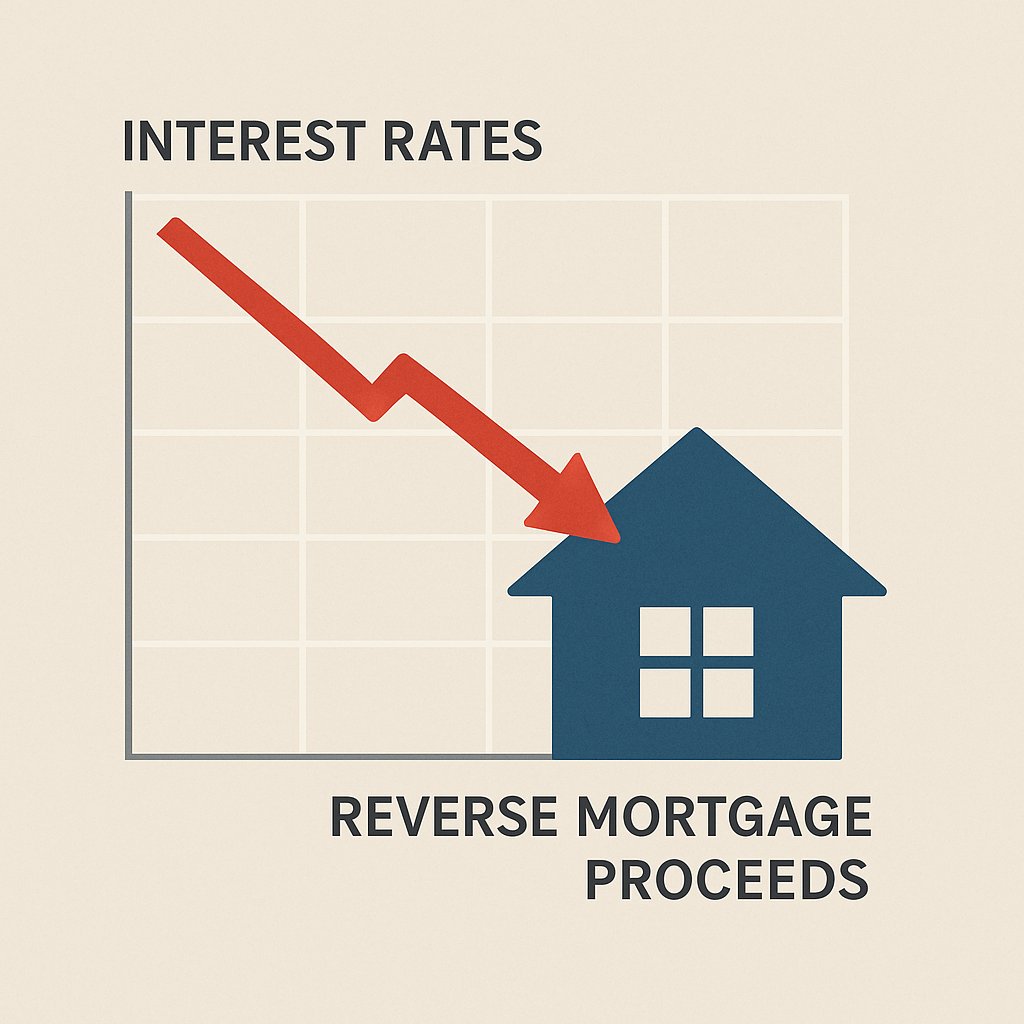
 Falling interest rates can increase the proceeds available from a reverse mortgage.
Quick take: The Federal Reserve cut its policy rate by 0.25% on September 17, 2025 and signaled it’s watching growth and inflation closely. Mortgage rates have eased, and if long-term yields continue to drift down, reverse mortgage “expected rates” could fall, which generally raises principal limit factors (PLFs)—meaning more available proceeds for seniors considering a refinance or buying with a HECM for Purchase. Federal Reserve
What the Fed just did—and why it matters
Fed move (Sept. 17, 2025): The FOMC lowered the policy rate a quarter-point; the Board also cut the primary credit rate to 4.25% effective Sept. 18. In its statement, the Fed noted moderating growth, slower job gains, and inflation that’s “somewhat elevated.” Chair Powell emphasized risks are becoming more balanced.
Debate about more cuts: Some officials are cautious about additional easing this year, while at least one Governor argued for steeper cuts. Translation: policy is data-dependent into October and December. Reuters
Where mortgage rates are heading into year-end
Right now: Freddie Mac’s weekly survey shows the 30-year fixed at 6.26% (week ending Sept. 18, 2025)—the lowest since October 2024. Freddie Mac
Short-term trend: MBA and major forecasters expect rates to remain around the mid-6s through late 2025, with only modest further easing. (Think ~6.6–6.7% averages.) Mortgage rates track the 10-year Treasury more than the Fed’s policy rate, but the Fed’s path influences those longer yields. The Mortgage Reports
Reverse Mortgage Mechanics: Why Lower Rates Can Mean More Money
For HECMs, two rates matter:
Initial/Note Rate – used to accrue interest (often tied to short-term CMT or SOFR on adjustables).
Expected Rate – the big one for proceeds; it’s typically 10-year CMT + lender margin on adjustables (for fixed HECMs, the expected rate equals the note rate). When the expected rate goes down, PLFs go up.
HUD, FHA, and CRS explain it this way: PLFs increase with age and decrease as the expected rate rises. So falling expected rates generally increase the principal limit (the total you can borrow). HUD
A simple illustration (how rate changes affect proceeds)
Independent industry examples show that for a 62-year-old borrower, a 0.50% drop in the expected rate can increase the PLF by a couple of percentage points of the home’s value (subject to the lending limit). For instance, sample PLFs for age 62 move from 33.4% at 6.5% expected rate to 35.7% at 6.0%—that’s ~2.3 points more of the MCA (lower of appraised value or HECM limit).
Why that matters: On a $600,000 MCA, that ~2.3-point improvement is roughly $13,800 more principal limit—before costs. (Actual results depend on age, margins, final underwriting, and HUD tables.)
Opportunities if Rates Drift Lower This Fall
1) Reverse Mortgage Refinance (HECM-to-HECM)
If your current expected rate is higher than today’s, a new HECM could increase your principal limit, potentially:
Unlocking more proceeds
Lowering your effective borrowing costs/margins
Converting an existing line of credit to a larger, growth-eligible line (on adjustables)
HUD’s own materials confirm PLFs (and therefore proceeds) rise when the expected rate falls. Pair that with home price appreciation and you may see compelling refi math. HUD
2) HECM for Purchase (buying your next home with less down)
With a HECM for Purchase, the down payment ≈ purchase price + closing costs − HECM principal limit. If lower expected rates raise the PLF, your principal limit rises, and the required cash to close can shrink—potentially moving a preferred price point or neighborhood into reach. (FHA lending limit for 2025 is $1,209,750, which caps the MCA.)
What to Watch Between Now and December
Fed meetings (Oct & Dec 2025): Market odds will shift with each jobs and inflation release. More easing is not guaranteed; officials are split, but the September cut has already helped ease yields at the margin. Reuters
Mortgage rate prints: Track Freddie Mac PMMS weekly updates for where the 30-yr lands (key signal for consumer sentiment and refi interest). Freddie Mac
10-year CMT: Because the HECM expected rate uses a 10-year index + margin, shifts in the 10-year Treasury and the 10-year CMT are the main lever for PLFs—more than the Fed funds rate alone.
FAQs (for featured snippets & rich results)
Q1: Do reverse mortgage proceeds really increase when rates fall?
A: Generally, yes. FHA’s methodology uses Principal Limit Factors that increase as the expected rate decreases (and increase with age). Lower expected rates → higher PLF → higher principal limit (subject to lending limit and costs). HUD
Q2: What index drives the reverse mortgage expected rate?
A: On adjustables, lenders typically use 10-year CMT + a margin. For fixed HECMs, the expected rate is the note rate.
Q3: Where are mortgage rates now?
A: Freddie Mac reported 6.26% for the 30-year fixed in the week ending Sept. 18, 2025. Forecasts suggest mid-6s into year-end, with only modest further easing expected. Freddie Mac
Q4: How does this translate to HECM for Purchase down payments?
A: A lower expected rate can raise the PLF, which increases the HECM principal limit and can reduce the cash you need at closing (purchase price + costs − principal limit). Lending limit applies.
Additional Resources:
Fed Sept. 17 statement & presser: official text & transcript. Federal Reserve
Freddie Mac PMMS (weekly mortgage rates): current and archive. Freddie Mac
HECM expected rate & PLFs: FHA/HUD/CRS explanations. HUD
Using a Reverse Mortgage to Buy a Home: What You Need to Know. V.I.P. Mortgage, Inc.
Eliminating Mortgage Payments in Retirement: How a Reverse Mortgage Can Ease the Financial Burden. V.I.P. Mortgage, Inc.
Thinking about a refi or buying with a HECM for Purchase?
With rates easing, you may qualify for more proceeds than earlier this year. I’ll run a no-obligation, scenario-specific quote showing today’s expected rate, PLF, and estimated loan proceeds.