
For most retirees, the goal is simple:
Stay independent.
Stay comfortable.
Stay at home for as long as possible.
In fact, numerous studies have shown that most older adults prefer to age in place rather than move into an assisted living facility or nursing home.
Yet aging in place often requires planning.
Healthcare needs change.
Mobility challenges arise.
Homes may require modifications.
Caregiving expenses can increase.
And for many families, the question becomes:
How can we help Mom or Dad remain safely in their home while maintaining quality of life?
We believe this conversation should include two important resources that are often overlooked:
🏡 Housing wealth
📱 Technology
Together, they may create more options for retirees who want to remain independent and age in place successfully.
Aging in Place Is Becoming the New Retirement Plan
The traditional retirement model often assumed that older adults would eventually move into assisted living or long-term care facilities.
Today, many retirees prefer a different path.
Advances in healthcare, home services, and technology have made it easier than ever for seniors to remain in their homes longer.
As a result, aging in place has become an important component of retirement planning.
But remaining at home is not always free.
Many retirees eventually face expenses related to:
- In-home caregiving
- Housekeeping assistance
- Meal preparation
- Transportation services
- Home modifications
- Medical equipment
- Personal care services
These costs can place significant pressure on retirement income and investment portfolios.
The Financial Challenge of Long-Term Care
According to long-term care research, one of the greatest financial risks facing retirees is the potential need for extended care services.
Even retirees with strong investment portfolios may find that healthcare and caregiving expenses increase over time.
This is especially true for individuals who wish to remain in their homes rather than relocate to a care facility.
Financial advisors often help clients prepare for these possibilities through:
- Long-term care insurance
- Investment planning
- Healthcare savings
- Income strategies
- Estate planning
However, one asset that is frequently overlooked is home equity.
Housing Wealth May Create Additional Options
For many retirees, the home represents one of the largest assets on the balance sheet.
Yet that equity often remains inaccessible unless the property is sold.
We believe housing wealth should be evaluated as part of a comprehensive long-term care strategy.
For some retirees, a reverse mortgage may provide access to housing wealth that can be used for:
- In-home caregiving
- Home modifications
- Healthcare expenses
- Emergency reserves
- Additional retirement cash flow
This does not mean a reverse mortgage is appropriate for everyone.
But it does mean housing wealth may deserve consideration when planning for future care needs.
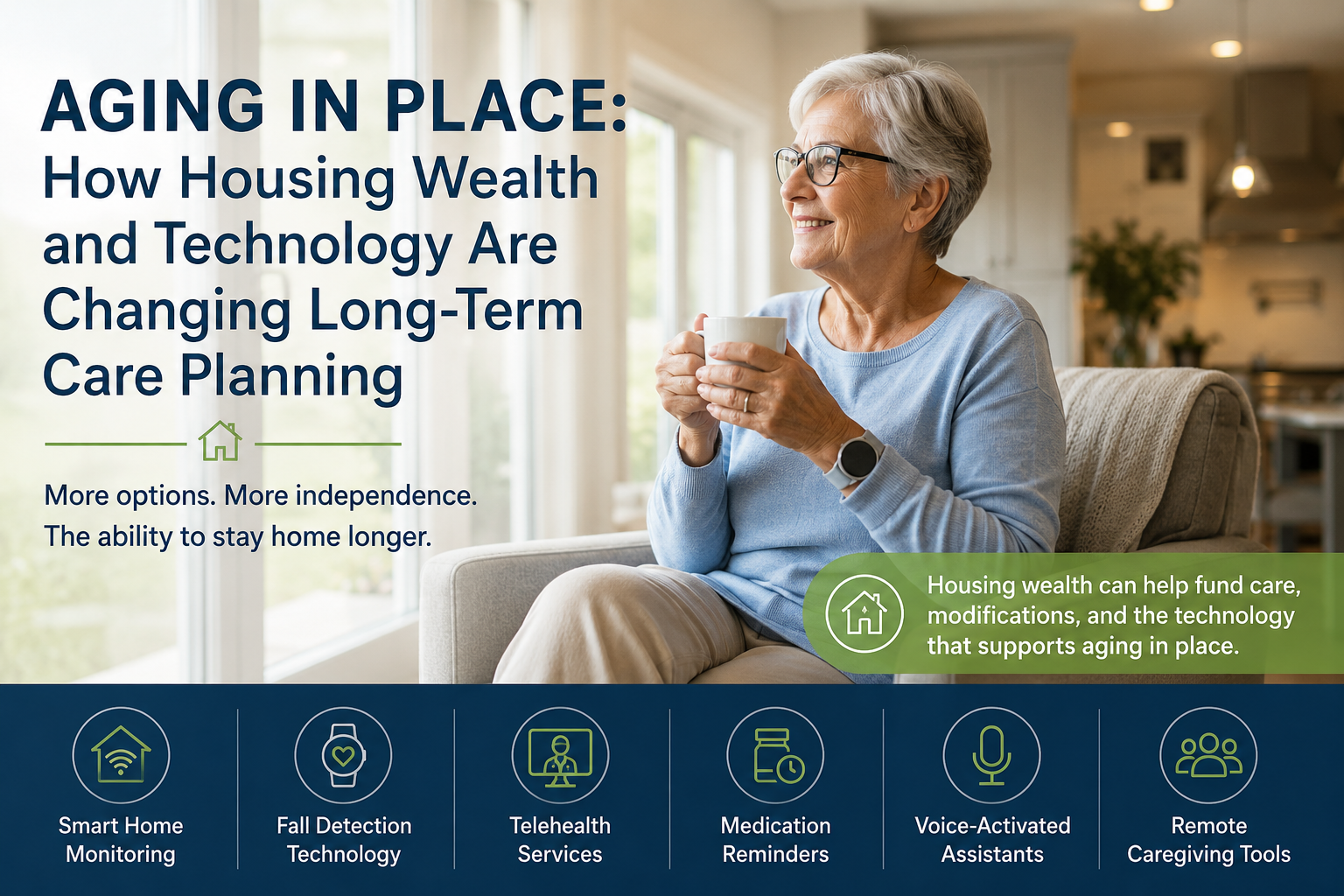
Technology Is Transforming Aging in Place
One of the most exciting developments in retirement planning is the rapid advancement of technology designed to help seniors remain safely at home.
Today, retirees have access to tools that were unimaginable just a decade ago.
Examples include:
Smart Home Monitoring
Motion sensors and smart home devices can help family members monitor activity patterns and receive alerts if unusual behavior occurs.
Fall Detection Technology
Modern wearable devices can automatically detect falls and notify emergency contacts.
Telehealth Services
Virtual healthcare appointments allow many seniors to consult with physicians without leaving home.
Medication Management Systems
Automated medication dispensers and reminder systems help reduce missed medications and improve compliance.
Voice-Activated Assistants
Technology such as voice-controlled devices can assist with reminders, communication, lighting controls, and emergency assistance.
Remote Caregiving Tools
Family members can now help monitor and support aging loved ones even when living in another city or state.
These innovations are helping retirees remain independent longer than previous generations.
The Home May Need to Evolve Too
Technology is only part of the equation.
Many homes require modifications to support aging in place safely.
Examples include:
- Walk-in showers
- Grab bars
- Wheelchair accessibility
- Wider doorways
- Stair lifts
- Improved lighting
- Non-slip flooring
While these improvements can significantly enhance safety and quality of life, they often require financial resources.
Housing wealth may help provide funding for these projects without requiring the sale of the home.
A Collaborative Planning Approach
Long-term care planning should not occur in isolation.
The most effective plans often involve collaboration between:
- Financial advisors
- Estate planning attorneys
- Healthcare professionals
- Family caregivers
- Reverse mortgage specialists
The goal is not simply preserving assets.
The goal is preserving independence, dignity, and choice.
Every family’s situation is different.
That is why thoughtful planning matters.
Looking Beyond Traditional Retirement Planning
Retirement planning is no longer just about investment performance.
Today’s retirees are also planning for:
- Longevity
- Healthcare costs
- Caregiving needs
- Housing decisions
- Lifestyle goals
Housing wealth may play an important role in addressing many of these challenges.
The question is not whether every retiree should use home equity.
The better question may be:
Could housing wealth help create more options for aging in place successfully?
For many retirees, the answer may be worth exploring.
Final Thought
Most retirees want the same thing:
To remain in the home they love, surrounded by the people, memories, and community that matter most.
As technology continues to improve and aging in place becomes increasingly achievable, retirement planning must evolve as well.
We believe housing wealth deserves a place in that conversation.
Not as a last resort.
But as one potential resource that may help retirees maintain independence, fund future care needs, and continue living life on their own terms.
Additional Resources:
Is Housing Wealth Right for Your Retirement Strategy?
Every retirement plan is unique, and using home equity isn’t the right solution for everyone. But for many homeowners age 55 and older, it can be an important tool for improving cash flow and increasing financial security.
Understanding how housing wealth fits into an overall retirement strategy can help you make more informed decisions about the future.
If you’d like to learn more about how a reverse mortgage may help strengthen your retirement plan or your client’s plan, we’re happy to walk you through the options.
Send us a note below to request more information.
About the Author
Rick Rodriguez, CRMP®, is the National Director of VIP Mortgage Reverse and has specialized in reverse mortgages since 2005. Recognized as one of the leading reverse mortgage professionals in the country, Rick works closely with retirees, financial advisors, real estate professionals, and other trusted advisors to help evaluate how housing wealth may fit within a comprehensive retirement plan.
As a national Certified Reverse Mortgage Professional (CRMP®), Rick is passionate about educating both consumers and professionals on the evolving role of home equity in retirement income planning. His writing focuses on retirement cash flow, housing wealth, Social Security strategies, portfolio preservation, and other planning concepts that can help retirees make more informed financial decisions.
Learn more at www.TheRetirementHomeLoan.com.
This material is for educational purposes only and is not intended as tax, legal, investment, or financial planning advice. Financial advisors should consult with appropriate professionals when evaluating strategies for individual clients. Reverse mortgage borrowers must meet program requirements and remain responsible for property taxes, homeowners insurance, home maintenance, and occupancy obligations.