
Why Some Retirees Use a Reverse Mortgage to Buy a Home—Even When They Could Pay Cash
If you have enough money to pay cash for your next home in retirement, should you?
It seems like an easy decision.
Pay cash. Own the home outright. No mortgage payment.
But there’s another question that deserves just as much consideration:
How much of your retirement money do you want tied up in your home?
For homeowners and homebuyers 55+, that’s an important conversation. A home may be one of your largest assets, but money invested in home equity isn’t the same as money you have readily available in savings, investments or other liquid accounts.
That’s why some financially secure retirees are choosing to finance a portion of their next home with a reverse mortgage—even when they have enough assets to pay cash.
The goal isn’t necessarily to borrow because they need the money.
It’s to keep more of their money available for retirement.
A Real-Life Reverse Mortgage Purchase
Here’s a recent example from a couple I worked with.
They were purchasing a $629,000 home and had substantial proceeds coming from the sale of their previous home.
They had choices.
They could have put considerably more cash into the new home.
They could have used a traditional mortgage.
Or they could finance a portion of the purchase using a Home Equity Conversion Mortgage for Purchase, commonly known as a HECM for Purchase.
After evaluating their options, they chose the reverse mortgage.
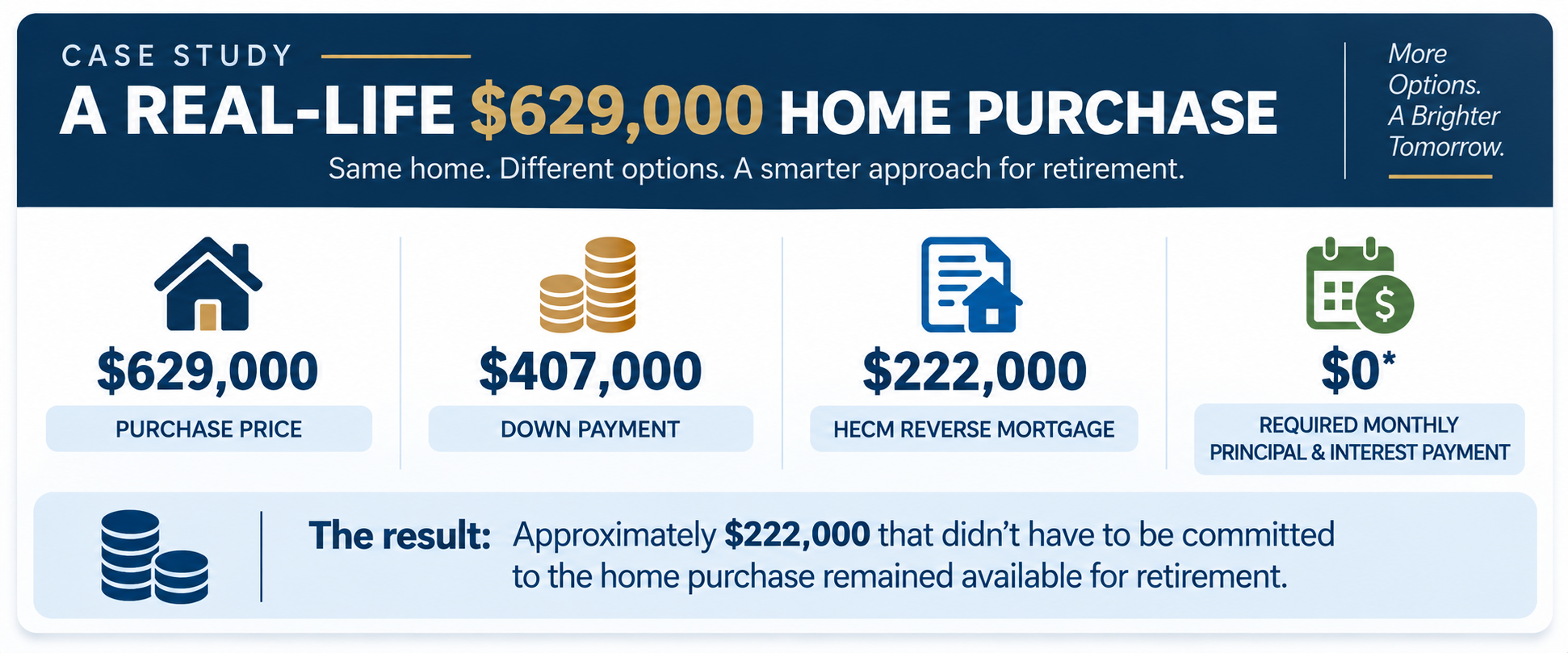
By financing approximately $222,000 of the purchase with the HECM, they avoided having to commit that additional $222,000 of their available cash to the purchase.
That was the real value of the strategy.
They purchased the home they wanted while keeping significantly more money available for retirement—and without taking on a required monthly principal-and-interest mortgage payment.*
Why Put 65% Down on a Home?
This is one of the first questions someone might ask when they see these numbers.
A reverse mortgage for purchase typically requires a substantial down payment—often considerably more than a traditional mortgage.
So why would someone put approximately $407,000 down on a $629,000 home?
Because that’s only half of the equation.
The other half is the approximately $222,000 they didn’t have to put into the home.
That money could remain available for whatever retirement brings.
Healthcare expenses.
Home repairs.
Travel.
Helping family.
Inflation.
Unexpected expenses.
Or simply maintaining a larger financial cushion.
The objective wasn’t to purchase the home with the smallest possible down payment.
It was to find the right balance between home equity, liquidity and monthly cash flow.
Three Ways to Buy the Same Retirement Home
Consider the three basic choices available to someone who has sufficient assets to purchase a home.
Option 1: Pay Cash
Paying cash is simple.
There is no mortgage and no monthly mortgage payment.
But if you pay $629,000 cash for a $629,000 home, you’ve moved $629,000 of your liquid assets into the property.
For some retirees, that’s exactly what they want.
For others, tying up that much capital in the home may leave less money readily available for the years ahead.
Option 2: Use a Traditional Mortgage
A conventional mortgage can allow you to preserve some of your cash.
But it also creates a required monthly principal-and-interest payment.
In retirement, that payment generally has to come from Social Security, pension income, employment income, savings or investment withdrawals.
So while a traditional mortgage preserves liquidity on the front end, it creates an ongoing monthly cash-flow obligation.
Option 3: Use a Reverse Mortgage for Purchase
A reverse mortgage for purchase offers another possibility.
Instead of paying for the entire home with cash, the homebuyer contributes a substantial down payment and the reverse mortgage finances the remaining portion.
Unlike a traditional mortgage, there is no required monthly principal-and-interest mortgage payment as long as the borrower continues to meet the loan obligations.*
For the couple in our example, that meant purchasing their $629,000 home while keeping approximately $222,000 from being tied up in the property.
The Real Question Is About Liquidity
Reverse mortgages are often associated with homeowners who need additional money during retirement.
That’s one use.
But it’s far from the only one.
I’ve worked with homeowners for more than two decades who have significant home equity, retirement savings and other assets.
For these homeowners, the reverse mortgage conversation can be completely different.
The question becomes:
“I have the money. How much of it do I want to put into my house?”
That’s an asset-allocation decision.
Your home is part of your overall retirement picture. So are your savings, investments, Social Security, pensions and other sources of income.
Putting additional money into the home increases home equity.
Keeping some of that money outside the home increases liquidity.
Neither is automatically right or wrong.
The important thing is understanding the tradeoff.
What About the Interest?
This is important.
A reverse mortgage isn’t free money.
Interest and applicable mortgage insurance and/or other financed charges accrue to the loan balance. If the homeowner chooses not to make voluntary payments, the loan balance will generally increase over time.
That means the homeowner will typically have less equity in the property in the future than if the home had been purchased entirely with cash, assuming everything else were equal.
That’s the tradeoff.
The homeowner is choosing to retain more liquidity today rather than putting more money into the property.
For some households, that’s attractive.
For others, maximizing home equity and minimizing debt may be more important.
That’s why I don’t believe the conversation should begin with:
“Should I get a reverse mortgage?”
A better question is:
“Which way of purchasing this home best supports my overall retirement plan?”
Cash vs. Traditional Mortgage vs. Reverse Mortgage
Before purchasing your next home in retirement, compare all three.
Ask yourself:
How much of my available cash will be tied up in the home?
How much liquidity will I have remaining after the purchase?
Will I have a required monthly mortgage payment?
Where will that monthly payment come from during retirement?
How important is maintaining access to my savings and investments?
What financial cushion do I want for healthcare, inflation and unexpected expenses?
How important is leaving maximum home equity to my heirs?
And, perhaps most importantly:
Which structure gives me the combination of liquidity, cash flow and financial flexibility that I want during retirement?
A Different Way to Think About Buying a Home After 55
One of the biggest misconceptions about reverse mortgages is that they’re only for people who are running out of money.
They’re not.
For the right homeowner, a reverse mortgage can be a strategic way to use home equity as part of an overall retirement plan.
That can be particularly important when purchasing a home.
If you’re 55+ and preparing to buy your next home, you may have more than two choices.
You can pay cash.
You can use traditional financing.
Or, depending on your age and circumstances, you may be able to use a reverse mortgage for purchase.
Before putting hundreds of thousands of dollars into your next home, compare all three.
Because the question isn’t simply whether you can afford to pay cash.
The better question may be:
How much of your retirement money do you want tied up in your home?
Rick R. Rodriguez, CRMP®
National Director of Reverse Mortgages
V.I.P. Mortgage, Inc.
Rick Rodriguez has worked in the reverse mortgage industry since 2005 and is a Certified Reverse Mortgage Professional (CRMP®). He helps homeowners, homebuyers, families and financial professionals understand how home equity and reverse mortgages can fit into retirement planning.
With a reverse mortgage, no monthly principal-and-interest mortgage payments are required. Borrowers must continue to meet the terms of the loan, including paying property taxes and homeowners insurance, maintaining the home and occupying the property as their primary residence. Failure to meet loan obligations may cause the loan to become due and payable. HECM reverse mortgages are FHA-insured and available to eligible borrowers age 62 and older. Certain proprietary reverse mortgage programs may be available beginning at age 55, subject to state and program availability. Loan proceeds and required down payment vary based on factors including borrower age, home value, interest rates and applicable program guidelines.