
Record senior housing wealth on one side. The lowest reverse mortgage volume in 23 years on the other. The distance between those two numbers is where most retirement plans are leaving money on the table.
By Rick R. Rodriguez, CRMP® — National Director of Reverse Mortgages, V.I.P. Mortgage, Inc. | NMLS #473353 | For homeowners age 55 and older — and for the planners, tax preparers, and realtors who advise them.
The equity is not abstract. It is sitting, street by street, in homes many owners bought decades ago.
America’s older homeowners have never been wealthier on paper — and never less likely to use the wealth they already own.
In the second quarter of 2026, housing wealth held by homeowners age 62 and older reached $15.34 trillion, surpassing $15 trillion for the first time, according to the Reverse Mortgage Market Index published by the National Reverse Mortgage Lenders Association (NRMLA) and RiskSpan.
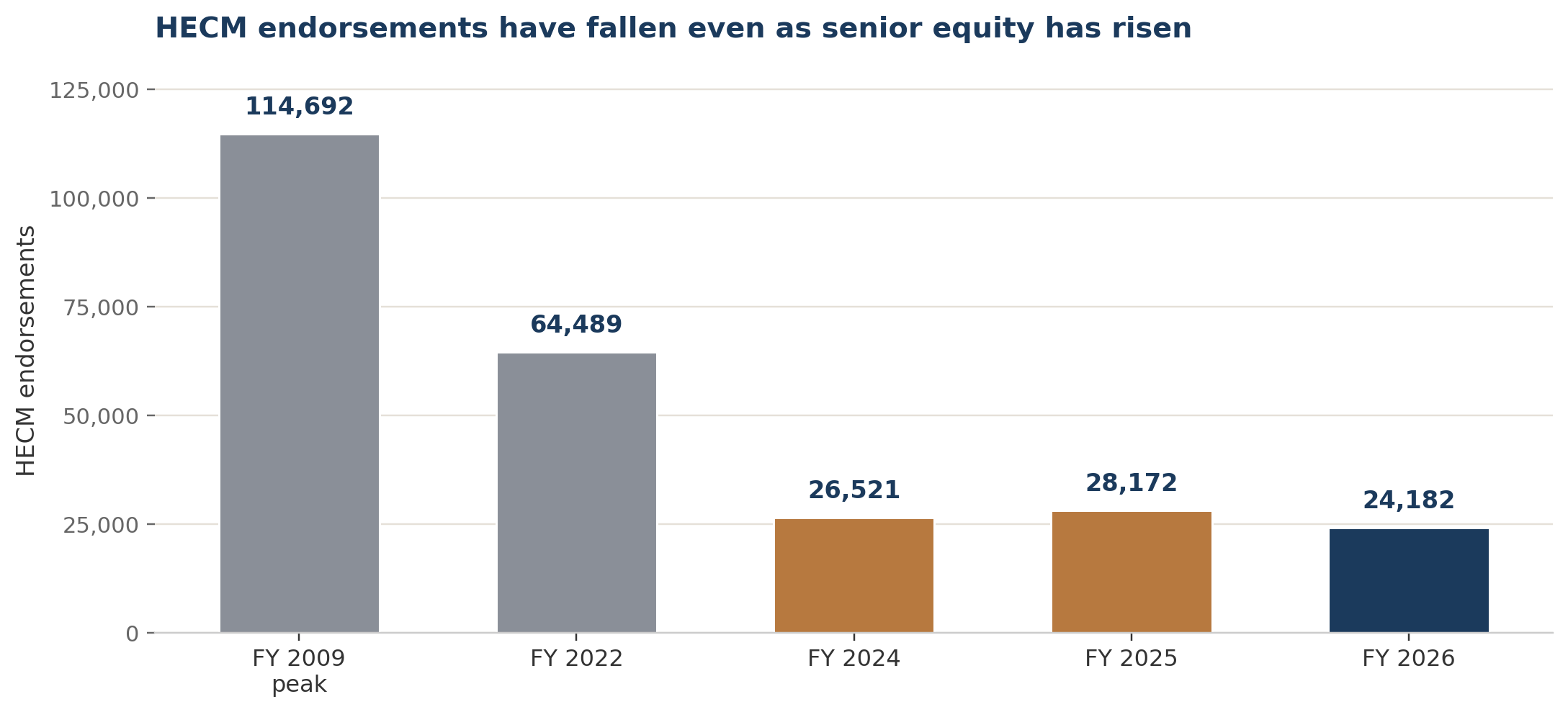
Set that beside the other number. Federal fiscal year 2026 closed with just 24,182 Home Equity Conversion Mortgages (HECMs) — the federally insured reverse mortgage — endorsed nationwide, according to U.S. Department of Housing and Urban Development (HUD) data compiled by NRMLA. That is down from 28,172 in fiscal 2025, and a fraction of the 114,692 endorsed in fiscal 2009.
| $15.34T Housing wealth held by homeowners 62+, Q2 2026 — a record, and the first reading above $15 trillion | 24,182 HECMs endorsed in FY 2026 — down from 28,172 in FY 2025 and 114,692 in FY 2009 | $1,249,125 2026 HECM maximum claim amount, up from $1,209,750 in 2025 |
That count is HECMs only — it does not include proprietary reverse mortgages, the private programs for homeowners as young as 55 that we also specialize in. That is the $15 trillion gap: not a shortage of wealth, and not a shortage of need. It is a shortage of conversations that treat the home as part of the retirement plan.
Interest is not the problem — conversion is
If nobody were asking, the low volume would explain itself. That is not what the summer showed.
Applications held near 3,000 a month through the summer of 2026, while September closed only 1,790 loans — the weakest month in more than six years. People are raising their hands. Far fewer are making it from first question to closing.
Anyone who has sat across a kitchen table from a 72-year-old homeowner knows why. The questions are reasonable, and they deserve straight answers: What will this cost? What happens to my spouse? What do my heirs inherit? Can I still sell? What do I still have to pay? When those questions meet jargon, old headlines, or a sales pitch instead of education, the file stops — and the equity stays locked up.
Three reasons the gap persists
Rates are the backdrop. Borrowing costs, including mortgage rates, remain elevated — a factor NRMLA itself cited alongside the record wealth figure. High rates have limited the use of home-equity products in recent years, and they change the math on every option, forward and reverse alike. They do not erase the need: for many owners, the alternative is carrying a monthly principal-and-interest payment well into their eighties, or selling a home they do not want to leave.
Cost needs a fair comparison. The HECM carries a 2% upfront mortgage insurance premium — a real cost that NRMLA has urged the Federal Housing Administration (FHA) to modernize, and one that is now pushing some borrowers to compare proprietary reverse mortgages, which do not carry FHA mortgage insurance. The honest answer is not that one product always wins. It is that a borrower deserves a side-by-side comparison — HECM, proprietary, and doing nothing — with total costs on the page. We specialize in both HECM and proprietary reverse mortgages, and we run that comparison before we recommend either. For many borrowers — homeowners age 55 to 61, owners of higher-value homes, and owners who want to avoid the upfront FHA premium — the proprietary option is the one that fits, and it belongs on the table from the first conversation.
Understanding is the drag. Forecasts for this market are not pessimistic. An EY-sourced outlook reported this fall puts equity release on a path to nearly triple by 2035, with limited understanding among borrowers and advisors named as a central drag on growth. In other words, the constraint is not demand for a better retirement. It is that housing wealth is still treated, by too many plans, as a last resort instead of a coordinated asset.
Housing wealth belongs inside the plan — not after it
A reverse mortgage is not a retirement plan. Used on its own, without coordination, it can be the wrong tool. Used inside a plan — alongside investments, Social Security timing, tax planning, and long-term care thinking — it gives a household options that a portfolio alone often cannot.
Eliminate a monthly mortgage payment. For a homeowner still carrying a forward mortgage, a HECM refinance — or a proprietary refinance, for homeowners as young as 55 and for higher-value homes — can remove the required monthly principal-and-interest payment. The borrower still owns the home and must still pay property taxes, homeowners insurance, and maintenance — but the monthly cash-flow change can be the difference between a plan that works and one that does not.
Set up a standby line of credit. The unused portion of a HECM line of credit grows over time. Established early and drawn deliberately — for example, in a down market year, so a portfolio is not sold at a loss to meet spending — it can act as a buffer rather than a lifeline. Proprietary structures differ by program, which is why we compare the line-of-credit mechanics side by side before a household commits.
Buy the right home without a monthly payment. HECM for Purchase lets qualified buyers age 62 and older buy a home — often the single-story, right-sized home — with a larger down payment and no required monthly mortgage payment, preserving cash that would otherwise go into an all-cash purchase. Proprietary purchase programs extend a similar no-required-monthly-payment structure to qualified buyers as young as 55 in many states.
Reach equity the HECM limit cannot. The HECM stops at the $1,249,125 maximum claim amount. Proprietary — or jumbo — reverse mortgages are designed for higher-value homes above that ceiling, carry no FHA mortgage insurance premium, and in many programs are open to homeowners as young as 55, including some condominiums that do not fit FHA rules.
Stay in the home, on purpose. For many people across the country, the goal is not leverage. It is staying: near doctors, family, community, and a home already fitted to their life. Equity used well can fund the care, modifications, and help that make staying possible.
“The challenge and opportunity for our industry is to ensure that older homeowners understand how this wealth can be responsibly incorporated into their broader financial plans.”
— Steve Irwin, President, NRMLA, on the Q2 2026 RMMI milestone
That word — responsibly — matters. Counseling is required for both a HECM and a proprietary reverse mortgage before the loan can proceed. Every HECM borrower completes counseling with a HUD-approved counselor, and proprietary borrowers complete required counseling under their program as well. It is a built-in, independent check, and good advisors treat it that way. Proprietary reverse mortgages are not FHA-insured and their terms differ from a HECM, so we walk households and their advisors through those programs’ terms, costs, and safeguards with the same care.
The same household math, in every state we serve
We see the gap in households across the country. In 55+ communities, established suburbs, and small towns, many owners bought years or decades ago. Their homes are often worth far more than they paid, and many are owned free and clear or with a small remaining balance. On a balance sheet, they are equity-rich.
Month to month, it can feel very different: rising insurance, property taxes, maintenance, and everyday costs on a fixed income — in a national survey conducted for Longbridge Financial this spring, 67% of homeowners age 55 and older named inflation and the rising cost of living as a major financial concern, ahead of health care costs at 43%.
Those two facts living in the same household — record wealth, tight cash flow — is exactly the gap. It is also why the conversation should start with a planner, a tax preparer, or a trusted realtor as often as it starts with a lender. The best outcomes we see are team outcomes.
A practical next step — education first
If you advise older homeowners, you do not need to become a reverse mortgage expert. You need a reliable place to send the question when it comes up — and it will come up, because your clients are sitting on the largest pool of housing wealth ever recorded.
Ask the housing question early. “How does your home fit your plan for the next ten to twenty years?” surfaces more than any product question ever will.
Compare, do not assume. HECM for homeowners 62 and older, proprietary reverse for homeowners as young as 55 and for higher-value homes, a home-equity line, downsizing, and doing nothing each have a place. Ask for the comparison in writing, with costs — we prepare it that way as a matter of course.
Keep the team in the room. Spouse, adult children where the homeowner wants them, planner, and tax advisor — surprises late in the process help no one.
Use the counseling step. Counseling is required for both a HECM and a proprietary reverse mortgage — HUD-approved counseling for a HECM, and required counseling under the proprietary program — and it is valuable even for households that decide against one. We lay out each program’s protections and obligations just as plainly.
If you are a homeowner, start the same way: with questions, not a commitment. A ten-minute conversation can tell you whether your equity could change your monthly picture, whether you are anywhere near the 2026 HECM limit or above it, whether at 62 a HECM fits or at 55 to 61 a proprietary program fits better, and whether the right answer for you is, in fact, to do nothing. Sometimes it is — and we will tell you that, too.
The wealth is real. The record proves it. The only question the $15 trillion gap leaves open is whether we will plan with it — deliberately, transparently, and early enough for it to do the most good.
About the author
Rick R. Rodriguez, CRMP® (NMLS #473353), is National Director of Reverse Mortgages at V.I.P. Mortgage, Inc., leading our nationwide reverse mortgage division. We are a nationwide lender, serving homeowners across the country. In the mortgage industry since 2003 and specializing exclusively in reverse mortgages since 2005, we work with HECM refinance, HECM for Purchase, and jumbo / proprietary reverse mortgages — including proprietary options for homeowners age 55 and older and for homes above the HECM limit. Rick is an accredited instructor with the CFP® Board and the Nevada Real Estate Division and hosts “Retirement With Rick.”
Talk it through: (702) 460-6222 | theretirementhomeloan.com
Sources
NRMLA / RiskSpan Reverse Mortgage Market Index, Q2 2026: $15.34 trillion in housing wealth for homeowners 62+, index 535.64; +$430 billion in home values, offset by +$30 billion in senior mortgage debt. Reported by HousingWire, “Senior housing wealth tops $15 trillion for the first time,” October 9, 2026. NRMLA, Annual HECM Production Numbers (HUD, through September 2026): FY 2026 — 24,182; FY 2025 — 28,172; FY 2024 — 26,521; FY 2022 — 64,489; FY 2009 — 114,692. HUD / FHA, 2026 loan limits: HECM maximum claim amount $1,249,125 for case numbers assigned on or after January 1, 2026. Longbridge Financial Home Equity Confidence Index (Morning Consult, 2,021 homeowners age 55+, March 26–April 5, 2026): 67% cited inflation / cost of living as a major concern; 43% cited health care costs. Application and September closing figures and the EY equity-release outlook are as reported in the author’s October 15, 2026 industry briefing.
Important information. This article is for education only and is not a commitment to lend, financial advice, or tax advice. Consult a qualified financial advisor and tax professional about your own circumstances. A reverse mortgage is a loan: interest and mortgage insurance (on a HECM) accrue and the loan balance increases over time. Borrowers must occupy the home as a principal residence, pay property taxes, homeowners insurance, and any HOA dues on time, and maintain the home; failure to meet these obligations can lead to foreclosure. Both a HECM and a proprietary reverse mortgage require counseling before the loan can proceed — a HECM requires counseling by a HUD-approved counselor, and proprietary programs require counseling under their program terms. Proprietary reverse mortgages are not FHA-insured and their terms differ. Many proprietary programs are available to homeowners age 55 and older, with eligibility and terms varying by state and program. Eligibility, amounts, and terms depend on age, home value, interest rates, and program guidelines in effect at application, and are subject to change.